Finland’s Relations and Development Cooperation in Kenya
Finland’s bilateral development cooperation with Kenya has improved the social status of women and promoted youth employment. In future, Finland will continue its development partnership with Kenya through regional collaboration, private sector instruments, and cooperation between higher education institutions and between civil society organisations. Finland is also actively involved in EU cooperation to promote the green transition and digitalisation in Kenya.
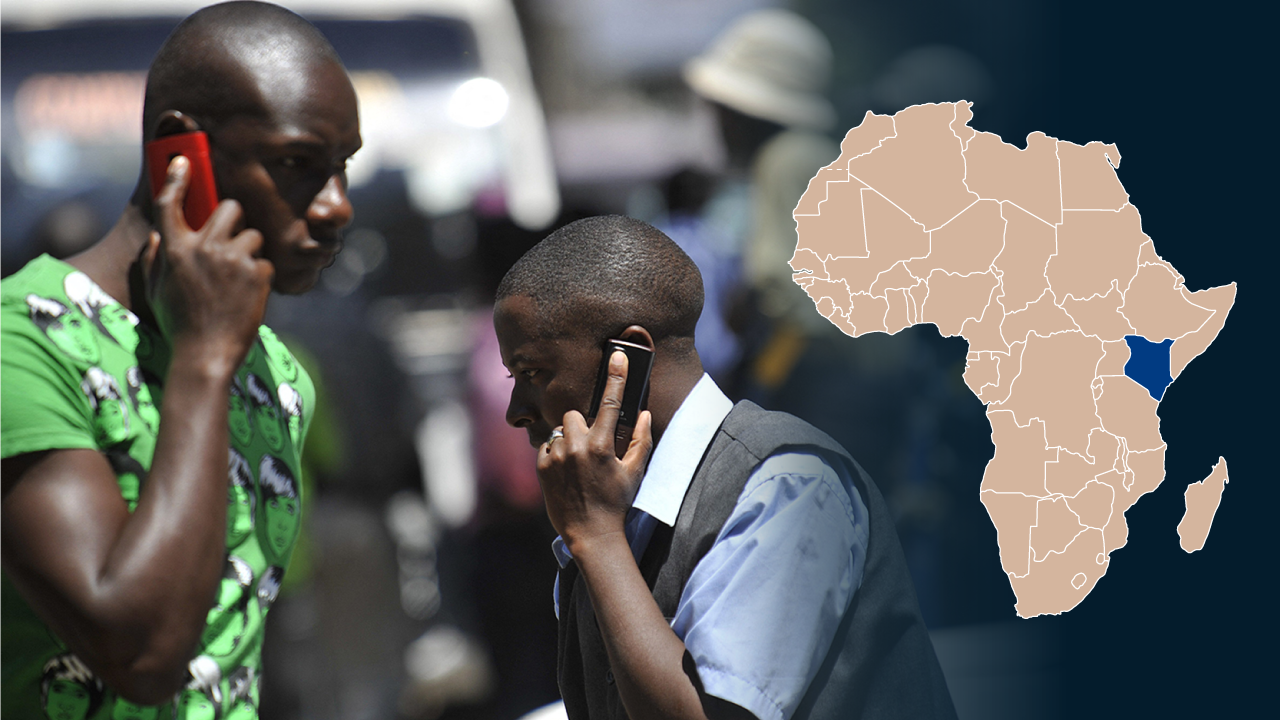
Youth unemployment is a huge problem in Kenya. Fuzu, a service established by Finns, helps jobseekers and employers to find each other. The service has nearly a million users in Kenya and its neighbouring country Uganda. Organisations that have supported Fuzu include, among others, Finnfund, BEAM and Finnpartnership. Photo: Simon Maina / AFP. Lehtikuva
Kenya is one of the most stable democracies in Africa. Thanks to its advanced Constitution and diverse economic structure, Kenya achieved the lower middle-income country status in 2015.
Even though the Kenyan economy has grown rapidly, poverty continues to be a problem: approximately one third of the population live below the national poverty threshold. Corruption drains a major part of public funds. Rapid population growth creates challenges for the education system, and young people find it hard to find employment. In the long term, terrorism and ethnic conflicts threaten stability.
Finland has been engaged in development cooperation in Kenya since the 1960s. Projects have been conducted in several areas, supporting the water sector, forest management, good governance and equality. In recent years, Kenya has become less dependent on development cooperation, and its relations with Finland have become more diversified. By the side of traditional partnerships, cooperation is carried out by the private sector, educational institutions and civil society.
In future, Finland, together with other donors, will work to promote Kenya’s efforts to achieve the UN Sustainable Development Goals (SDGs) and the country's own national development goals.
The objectives of Finland’s comprehensive activities in Kenya are described in the Country Strategy and the Country Programme for Development Cooperation. The main objectives for the Country Strategy for 2021–2024 were to support stability in Kenya, to improve the position of women and young people, to boost sustainable and inclusive economic growth and to mitigate and adapt to climate change. Finland has not launched a new country programme for development cooperation for Kenya after the 2021–2024 programme.
Finland’s Country Strategy for Kenya 2021–2024 (PDF, 302 KB)
Outcomes of Finland’s development cooperation in Kenya in 2021–2024
Finland’s bilateral cooperation in Kenya in 2021–2024 focused on improving women’s opportunities for participation in society, reducing violence against women, further developing technical and vocational education for young people and increasing decent job opportunities. The financial frame for 2021–2024 was approximately 32 million euros.
Finland’s Country Programme for Development Cooperation in Kenya (PDF, 559 KB)
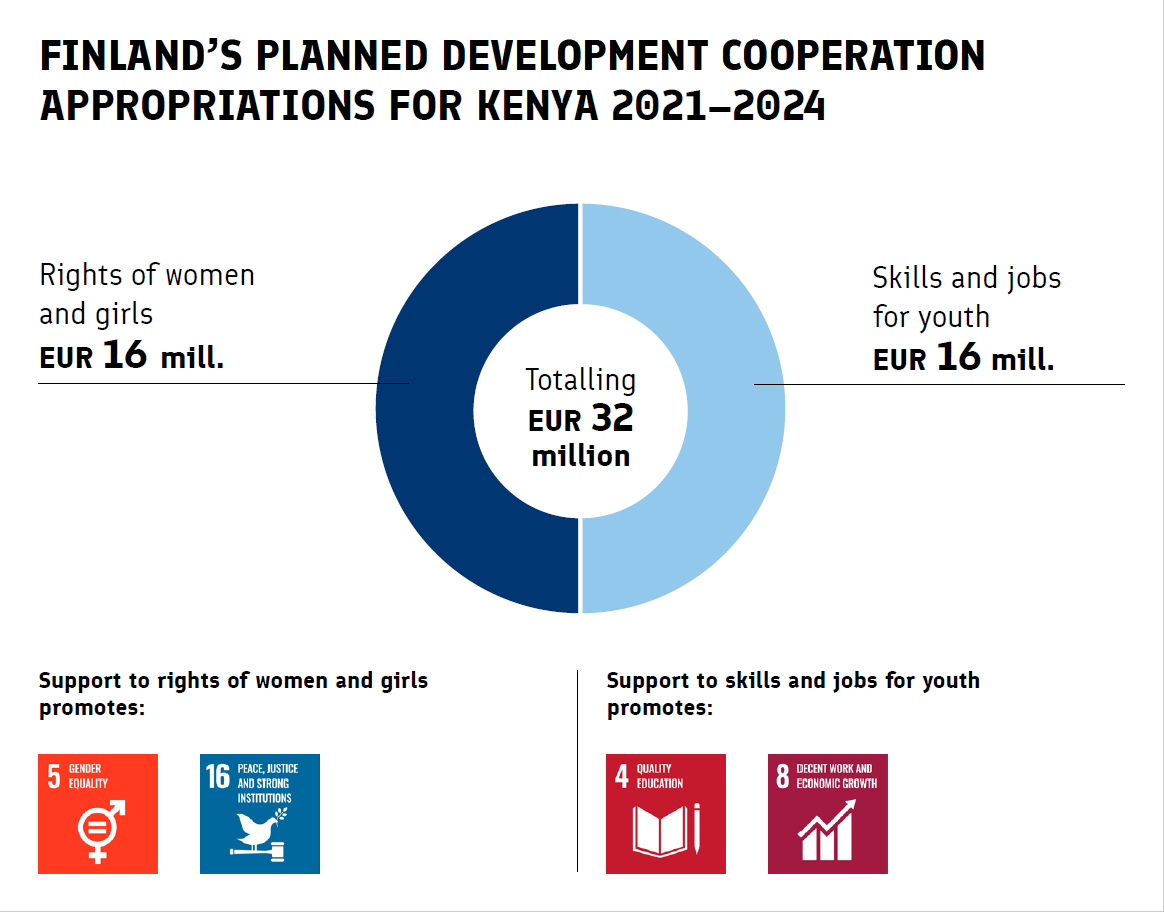
In the previous programming period in 2016–2020, Finland concentrated on developing responsible and decentralised administration, supporting jobs and livelihoods, and improving the position of women and girls.
Finnish development cooperation supports the rights of women and girls
Finland’s development cooperation supports women’s opportunities for participation in public decision-making and peace processes and helps to reduce gender-based violence.
Expected outcomes: Women play an important role in decision-making and all women and girls are protected against the threat of violence
- Women have enhanced opportunities for participation in leadership and decision-making roles in society
- In accordance with UN Security Council Resolution 1325, women participate in peace processes, and the safety of women and girls is guaranteed
- Gender-based violence is better prevented, and more effective measures are employed to combat the threat of violence
Ongoing programmes and projects
- Support for participation in projects run by UN Women, focusing on public decision-making (Women in Leadership) and peace processes (Women, Peace and Security) and for fighting gender-based violence (Gender-Based Violence, GBV). The projects will cover the years 2020–2024, and the funding will amount to EUR 4.86 million.
- Strengthening citizens’ participation in preventing gender-based violence (GBV) in 2021–2022. CSO partnership with a funding of EUR 2 million.
- Bilateral programme on Prevention and Response to Gender-Based Violence. The project will be implemented in 2021–2024. Finland will allocate EUR 5 million for the project.
- Use of the Fund for Local Cooperation (FLC), for example to implement the 1325 National Action Plan at local level.
Boosting decent employment
Finland’s development cooperation supports the technical and vocational education and training of youth and their opportunities to find decent jobs with an adequate income.
Expected outcomes: Young women and men gain better vocational skills and competences and get decent jobs
- Young people are offered good technical and vocational education and training
- More decent jobs are created for young women and men
Planned programmes and projects
-
A joint project with Germany to improve technical and vocational education and training (TVET) in Kenya. Finland's contribution to the project is EUR 8 million for the period 2023-2026.
-
IFAD project to promote youth employment and entrepreneurship in agribusiness. Finland's contribution to the project is EUR 8 million for the period 2023-2026.
Highlights of the Results Report 2021-2024
The elections held in Kenya during the programme period in 2022 were relatively peaceful. However, towards the end of the period, civil society weakened and the employment situation for young people remained poor. At the same time, the impacts of climate change in Kenya became increasingly evident in the form of unprecedented long drought and the flooding that ensued.
Finland supported women's participation in politics through the bilateral country programme by promoting new legislation and the implementation of the Constitution through UN Women. The proportion of women in Parliament and other levels of administration increased slightly in the 2022 elections but does not yet fulfil the constitutional requirement that one gender must not occupy more than two-thirds of public offices.
The implementation of the UN Resolution on Women, Peace and Security was promoted through the actions plans of 18 counties. The proportion of women in the counties' peace committees rose to 34 per cent.
Finland supported action against gender-based violence through UN Women, a bilateral project and the Kenyan Red Cross. An increasing number of victims had access to essential support services during the programme period. A total of 5,000 police officers, healthcare workers, public officials in the judiciary and administration, teachers and community leaders in seven counties were given training in the topic. Religious and other leaders in communities were engaged in supporting efforts to change harmful attitudes and practices, such as female genital mutilation. At the same time, the legal and political framework for combating gender-based violence was improved.
At the beginning of 2023, Finland and Germany launched a new project to improve the employment of Kenyan young people by promoting the introduction of work-oriented apprenticeships in vocational education and training in the country. The project already involves nearly 100 educational institutions, over 1,500 companies and around 10,000 students, which clearly exceeds the original objectives. At the beginning of 2024, the Kenyan government adopted a new national policy on apprenticeship training to support the model’s introduction and sustainability in the long term. In addition, the project has built partnerships between seven Finnish and over 20 Kenyan educational institutions, creating a strong foundation for long-term cooperation and raising the profile of the Finnish education sector in Kenya.
In 2024, Finland started cooperation with the International Fund for Agricultural Development (IFAD) with the aim to improve the livelihood and employment of young women and men in green agribusiness in 14 counties. In addition, development financing instruments of the Finnish private sector were increasingly used in Kenya to deepen the relationship between trade and development.
Finland’s partners in Kenya
Finland works in Kenya as a member of the European Union and the donor community. As an EU Member State, Finland participates in the EU’s dialogue with the Government of Kenya, where the country is encouraged to develop good governance and democracy, to uproot corruption and to make effective use of its own resources. The EU’s key initiatives in Kenya are related to green growth and digitalisation, and Finland takes an active part in both of them.
Finland also supports economic and social development in Kenya by providing funding for UN organisations and international development finance institutions. Finland provides needs-based humanitarian assistance especially via humanitarian organisations of the UN and Finnish civil society organisations.
Several Finnish civil society organisations support the development of Kenyan society in collaboration with the country’s civil society actors. The support focuses, for example, on promoting human rights and the position of women and persons with disabilities.
Team Finland cooperation
Team Finland in Kenya aims to promote the image of Finland and to highlight Finland’s strengths.
Compared to other East-African countries, Kenya is a big and diverse economy with a fast-growing middle class. Team Finland works to strengthen the commercial relations between Finland and Kenya especially in the following areas: infrastructure development, energy, agriculture, water services and information technology.
Finland’s objective is to double its trade with African countries in 2020–2030. During the same period of time, efforts will be made to significantly increase Finnish companies’ investments in Africa and African companies’ investments in Finland. Finland supports, for example, TradeMark Africa in order to enhance Finnish companies’ opportunities to trade in Kenya and other East African countries.