Finland’s relations and development cooperation in Myanmar
The bilateral country programme between Finland and Myanmar was completed in 2024. Finnish development cooperation in Myanmar has focused on promoting peace and the foundations of democracy as well as on securing the rights and opportunities of children to attend school.
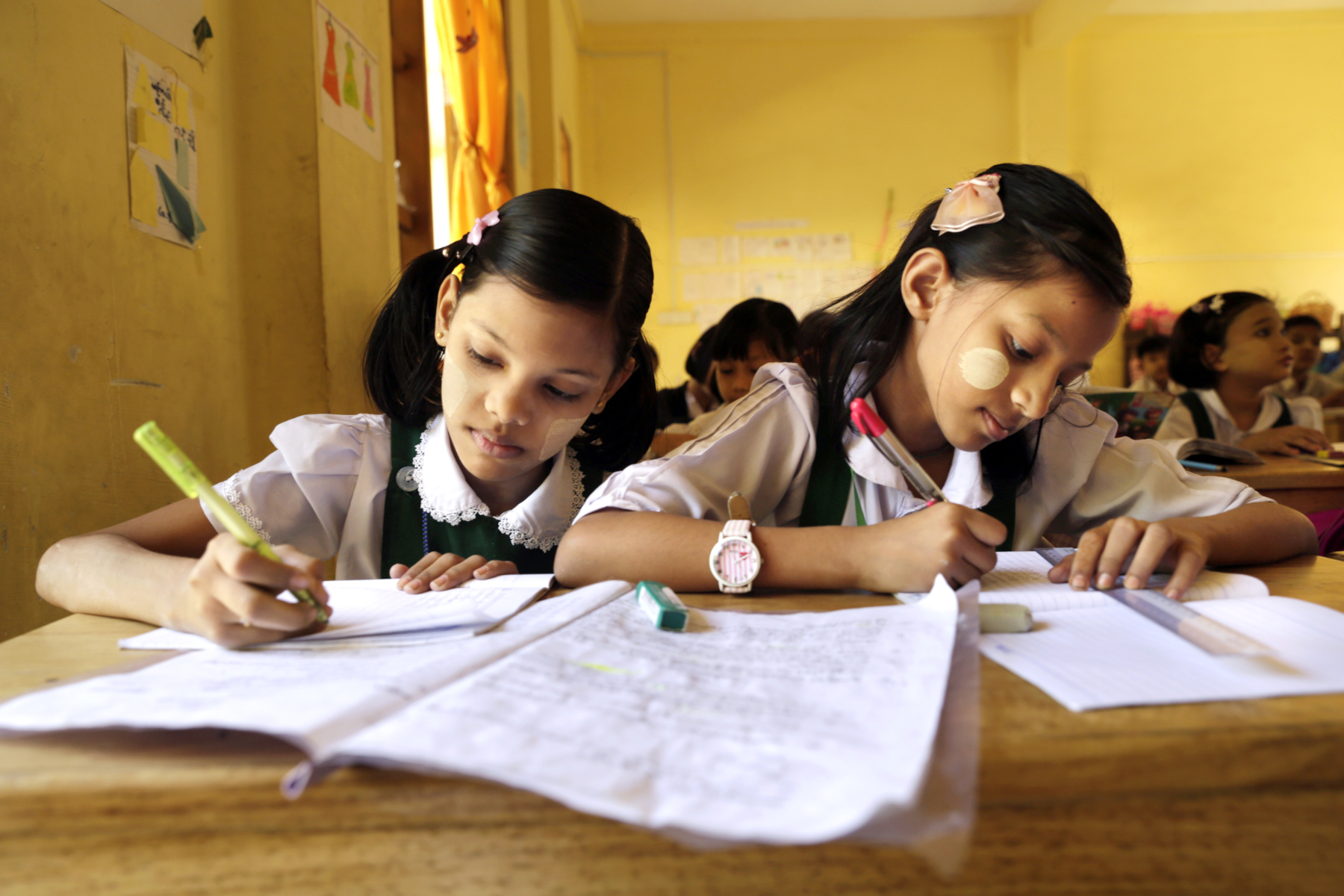
Pupils at school in Yangon. Finland has promoted the opportunities of children to attend school in the midst of the emergency situation. Support has been channelled to the most vulnerable children, for example, in ethnic and conflict-affected areas. Photo: Liisa Takala
The military seized power in Myanmar on 1 February 2021. Following the previous 50-year period of military rule, Myanmar had been on the path towards democracy for just over a decade.
In the 2021 coup, the military arrested the country’s elected leaders, preventing the newly elected parliament from convening. The army and the police have arrested and killed demonstrators and bystanders. The military regime has suppressed information and communications channels.
The coup was followed by widespread demonstrations and the creation of a civil disobedience movement. The power struggle continues, and violence has spread. Conflicts between ethnic armed organisations and the Myanmar military have also increased in different parts of the country.
Due to the coup, it has become difficult to continue development cooperation projects. International organisations and civil society organisations are facing major barriers to operating in Myanmar. The military regime is restricting and controlling the activities of civil society. Activities have gradually shifted from traditional development cooperation to supporting the fundamental prerequisites for people's survival. The need for humanitarian assistance has multiplied since the coup.
Myanmar has been one of Finland’s partner countries for development cooperation since 2012. Under the current circumstances, Finland has continued its development cooperation to a limited extent. Support has been directed to peace and democracy and to decent living conditions. The rights and opportunities of children to attend school has been a particular focus.
Finland continues to support the people of Myanmar after the military coup
Before the military coup, Finland’s development cooperation through the Country Programme for Myanmar was approximately EUR 16 million a year. Later, it was decided that the Country Programme will conlude at the end of 2024, aligning with the Finnish Government Programme's timeline. After the coup, Finland has already made significant cuts to this support. Because of the current uncertainties in the operating environment, the situation is under constant monitoring, since it is important to ensure that support reaches the people most in need. With the end of the Country Programme, support for peace projects will be reduced and support to the education sector will cease at the end of the current contractual periods.
Projects that were implemented in collaboration with the civilian administration have been discontinued, because the army ousted the civilian administration. This is to ensure that Finnish funding will not benefit the military regime.
Funding allocated for development cooperation will not be channelled to the state budget, which is administered by the armed forces, nor to the administration in power during the state of emergency, which was appointed by the armed forces. Finland supports the people in Myanmar via the UN agencies and other international actors as well as via civil society organisations.
Finland has supported peace and the foundations of democracy
Myanmar has suffered from internal armed conflicts for over 70 years. Conflicts have erupted mainly in the ethnic minority areas in the border regions. After the military coup, unrest has spread across the country and the need to find a peaceful resolution extends to the whole country.
Finland has promoted peace and democracy at the grassroots level by supporting, for example, the media, CSOs and youth groups that promote peace at local level. Support for civil society has been channelled to maintain skills and expertise that advance peace and democracy. Finland has also supported unofficial peace talks carried out between the different parties of the conflicts.
Expected outcome: Return to inclusive peace process
- Conflict stakeholders have increased capacity and readiness for non-violent solutions
- Women and youth have the capacity and possibilities to participate meaningfully in peace discussions
- Community-led peace initiatives facilitate non-violent solutions at the local level
- Democratic stakeholders and emerging political actors have the capacity, tools and information relevant for building federal democracy
- Civil society actors, including women’s organisations supported to preserve civic space, mechanisms to accountability and continue their work
Finland has promoted life-sustaining activities, particularly the rights and opportunities of children to attend school
Finland has promoted the opportunities of children to attend school in the midst of the emergency situation. Support has been channelled to the most vulnerable children, for example, in ethnic and conflict-affected areas. Finland has supported education services, monastery schools and community-led means of arranging teaching in ethnic areas.
Expected outcome: Learning opportunities for children will be secured in the emergency situation
- Development partners work together to promote the right to quality and inclusive education
- Community-led education providers support continuous learning at local level
- Educators receive pedagogical training on inclusive and multi-lingual education
- Inclusive teaching and learning materials are produced to catch-up learning and to support development pathways to teachers
In addition to the two main expected outcomes described above, Finland has continued its support for rural livelihoods. This support has been channelled to a coffee cooperative in Shan State, which provides impoverished farmers with a legal means of subsistence in place of cultivating opium poppy. The expected outcome has been that rural communities and households will become more resilient through maintaining sustainable, adaptive agricultural value-chains.
Highlights of the Results Report 2021–2024
The military coup at the start of the programming period in February 2021 plunged Myanmar into an ever-deepening spiral of violence. Over the four years, the fighting was widespread, and more than three million people had to leave their homeland. At the end of the programming period, approximately 20 million people, or one third of the population, needed humanitarian assistance, and the human rights situation remained poor.
Finland supported efforts towards an inclusive peace process and a transition to a democratic federal model by funding UN and civil society organisations. Funds were allocated for strengthening the capacity of temporary democratic institutions and ethnic organisations. Projects related to the federalisation process and democracy reached more than 14,000 people. Support was also provided for drawing up draft constitutions in all seven ethnic states and two regions inhabited by the majority population. Towards the end of the programming period, a large number of resistance actors defending democracy agreed on a common roadmap to federal democracy in a process supported by Finland.
Finland provided funding to keep children’s schooling going amidst the conflict. In the final year of the programming period, the projects supported by Finland reached more than 660,000 children and young people. Nearly 350,000 learners were reached through local education providers, such as ethnic organisations and monastery schools. At the same time, training was provided to more than 15,000 teachers. In addition, the support to community-based learning centres, provided through the UN, reached more than 317,000 children.
Finland’s close cooperation with the other Nordic countries in the Nordic House in Myanmar boosted the countries’ joint impact.
Finland’s partners for cooperation in Myanmar
Finland maintains regular dialogue with the UN, the EU, the Nordic countries, international organisations and other donors on a common approach and shared principles. It is particularly important to have a joint position towards the military regime and not to legitimise the military rule.
Finland cooperates only with reliable and long-term partners operating in the country. Support will be channelled through CSOs, the UN and other development actors, provided that their operating conditions in the country are maintained, and there is an agreement on jointly adopted principles.
Furthermore, Finnish development funding is being channelled to Myanmar through civil society and humanitarian assistance. Development cooperation funding can also be used for humanitarian work.