
MPs visit Geneva to gain insight into challenges facing multilateral cooperation and humanitarian assistance
A delegation from the Finnish Development Policy Committee (DPC) visited Geneva on 21–23 October. The delegation, comprising six Members of Parliament (MPs) and representatives of civil society organisations, explored the future of the multilateral international system and global development challenges.
Meetings with leaders of international organisations focused on themes including the future of the UN and the humanitarian system, human rights, mediation, disaster risk anticipation and international trade.
“We want to gain insight into issues that will shape the future of the international community as a whole, including Finland,” says delegation lead MP Jani Kokko (Social Democratic Party), Vice-Chair of the DPC.
Geopolitical tensions, a growing number of conflicts and rising humanitarian needs are challenging the functioning of the rules-based international system and multilateral cooperation.
“It is important for Finnish decision-makers to understand how multilateral cooperation can respond to global crises, safeguard human rights and advance sustainable development,” Kokko says.
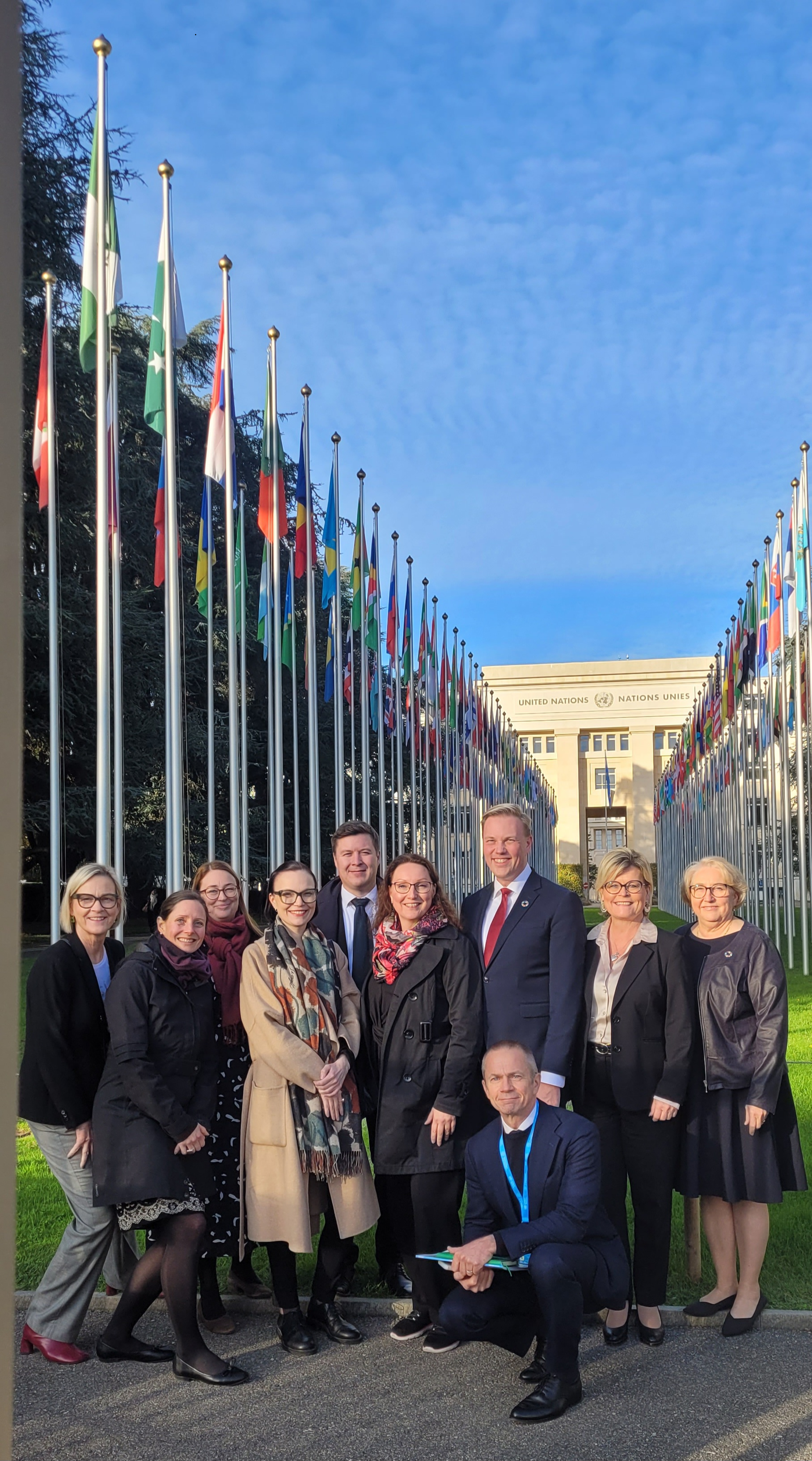
The other members of the delegation were MPs Sari Tanus (Christian Democrats), Inka Hopsu (The Greens), Minja Koskela (Left Alliance), Eva Biaudet (Swedish People’s Party) and Tuomas Kettunen (Centre Party).
Extensive overview of the work of international organisations
Geneva is one of the most important centres of international cooperation. The city is a base for numerous UN agencies and other international organisations whose work influences global development and promotes humanitarian assistance and the realisation of human rights.
During their three-day visit, the delegates met, among others, Ngozi Okonjo-Iweala, Director-General of the World Trade Organization (WTO), and Awa Dabo, UN Deputy High Commissioner for Human Rights.
They also met representatives of the UN Office for the Coordination of Humanitarian Affairs (OCHA), the UN Refugee Agency (UNHCR), the International Committee of the Red Cross (ICRC) and the International Federation of Red Cross and Red Crescent Societies (IFRC).
The delegation visited Interpeace, an international peacebuilding organisation, to discuss the changing context of mediation. The delegation also met Pekka Haavisto, the UN Secretary-General’s Personal Envoy for Sudan.
On the final day of the visit, the delegation learned about cooperation between the World Meteorological Organization (WMO), the United Nations Office for Disaster Risk Reduction (UNDRR) and the International Telecommunication Union (ITU). The ‘Early Warnings for All’ initiative aims to reduce the damage disasters inflict on people, their livelihoods and national economies.
“A common thread running through all our discussions was the status and rights of persons with disabilities. Disaster information that takes the needs of persons with disabilities into account improves communication for everyone while also strengthening preparedness across society,” says Sari Tanus (Christian Democrats), Second Vice-Chair of the DPC.
The Development Policy Committee is the only body dedicated to the systematic and broad-based monitoring and analysis of Finnish development cooperation and development policy. The government appoints the Committee for the duration of the government's term. Its members represent parliamentary parties, advocacy organisations, civil society organisations and universities in the Finnish University Partnership for International Development (UniPID) network.